If you are a business owner or a marketer, you likely rely on data to make decisions. One of the most important concepts you need to master is marketing attribution. In simple terms, marketing attribution is the process of identifying which marketing touchpoints drive sales or conversions. For many years, we relied on simple links to tell us where our customers came from.
Traditional tracking methods are hitting a wall. You might notice that your reports do not match your actual sales numbers. This happens because the journey a customer takes is now very complex. They might see an ad on their phone, then look at your website on a laptop and finally buy something after clicking an email. This guide will help you understand why the old system is broken and what you can do to fix your marketing measurement.
What Is Marketing Attribution And Why Does It Matter?
Before we look at the future, we must understand the basics of marketing attribution. It is the strategy used to assign credit to different marketing actions. When a customer buys a product, they usually interact with your brand several times. Attribution helps you decide which of those interactions deserves the most credit for the money earned.
Without a solid plan for marketing attribution, you are basically guessing. You might spend thousands of dollars on Facebook ads, thinking they work when in reality your YouTube videos are doing the heavy lifting. Good attribution allows you to spend your budget wisely. It ensures that every dollar you invest is actually helping your business grow.
Understanding the customer journey is the main goal here. We want to see the path from the first time someone hears about us to the moment they become a loyal customer. In the past, this was easy to see, but today it requires a more advanced approach to marketing analytics.
Why Is the Attribution Model Important?
An attribution model determines how credit is assigned to each touchpoint in the buyer’s journey. Without it, marketers risk overvaluing some channels while undervaluing others. A clear attribution model helps identify the most effective campaigns, optimize marketing budgets, and refine strategies for better conversions. Key benefits:
- It helps you stop wasting money on paid promotional channels that do not generate any sales.
- You can see exactly which messages resonate most with your target audience.
- It allows you to justify your marketing spend to your stakeholders.
- You gain a deeper understanding of how long it takes for a person to decide to buy.
What Is Traditional UTM Tracking?
UTM (Urchin Tracking Module) tracking uses tags added to URLs to monitor the performance of marketing campaigns. For decades, we have used UTM tracking to organize our data. UTM parameters are small bits of code added to the end of a URL. They tell your analytics software where a visitor came from. For example, a link might tell you the source is Google and the medium is a paid ad.
These tags were the backbone of traditional tracking for a long time. They allowed marketers to see which specific links were being clicked. If you sent out a newsletter, you would use a unique UTM link to see how many people clicked through from that specific email. This system worked well in a world where people stayed on one device and used one browser.
However, UTM tracking is just a data collection method. It is not a complete strategy by itself. It provides the ‘labels’ for your traffic, but it does not tell the whole story of the customer journey. It is a session-based tool, which means it only knows what is happening during one specific visit to your site.
Traditional UTM parameters usually include:
- The source that identifies the platform, such as Google or Facebook.
- The medium, which shows the type of traffic, such as organic or PPC.
- The campaign name groups all links for a specific promotion.
- The content tag which helps you test different versions of the same ad.
What Is the Connection Between Marketing Attribution & UTM Tracking?
Marketing attribution and UTM tracking are closely linked because UTMs provide the raw data that makes attribution possible. Attribution models aim to assign credit to different marketing touchpoints in a customer’s journey, but without tracking the user’s interactions, this task becomes nearly impossible. UTMs act as identifiers that tell your analytics platform where traffic is coming from and which campaigns are influencing conversions.
For example, imagine you run a campaign promoting a new eBook. A user clicks a Facebook ad, later reads a blog post on your site and finally downloads the eBook through an email link. UTM parameters on each link track the source, medium and campaign details. When this data is fed into your attribution model, it helps determine how much credit to assign to the Facebook ad, the blog post and the email.
In short, UTMs provide the visibility and structure that attribution models rely on to accurately analyze and assign credit across the buyer’s journey.
Why Traditional UTM Tracking Is Failing in Marketing Attribution?
You might be asking why marketing attribution is broken. The answer lies in how the internet has changed. Traditional UTM tracking problems have become too big to ignore. The first major issue is cookie deprecation. Most web browsers now block the small files used to track people across different websites.
If someone clicks a UTM link on Monday and returns to purchase on Friday, the system may treat them as two separate users. This disconnect weakens attribution accuracy and makes campaign performance appear lower than it truly is. The connection between awareness and conversion gets lost.
What happens when cookies are blocked:
- The same user is recorded as multiple users
- Multi-day journeys cannot be connected
- UTM-based attribution becomes incomplete
- Conversions appear to come from ‘direct traffic.’
- Campaign performance looks weaker than reality
Another major challenge is the rise of the dark funnel. The dark funnel refers to interactions that happen outside measurable channels. Many conversations, shares and recommendations occur in private spaces where traditional analytics tools have no visibility.
For example, a buyer may:
- Discover your product through a LinkedIn post
- Discuss it in a private Slack group
- Read peer feedback shared in a WhatsApp chat
- Search your brand name directly on Google
- Complete the purchase
In analytics reports, this journey may show up as direct traffic, even though multiple touchpoints influenced the decision.
The impact of the dark funnel:
- Early-stage influence remains invisible
- Trust-building moments are not recorded
- Attribution models miss key interactions
- Marketing ROI becomes harder to measure accurately
The Hidden Gaps in UTM-Based Attribution
UTM tracking plays a key role in measuring campaign performance, but it does not always capture the complete picture. Several technical and behavioral factors can create gaps that affect attribution accuracy and reporting.
While UTMs are useful, they face limitations that can impact the accuracy of attribution. Such as 👉🏻
Data Privacy
Privacy regulations and cookie consent banners reduce the amount of data that can be collected. If users reject cookies, sessions cannot be tracked completely, leaving gaps in attribution.
Data Loss During Redirection
UTM parameters can be lost when links pass through certain redirects, tracking scripts, or in-app browsers. This can cause conversions to appear as ‘direct traffic’ even though multiple touchpoints influenced the sale.
Human Error
Inconsistent naming conventions, typos or missing UTM parameters can result in fragmented or misleading data, making it harder to analyze campaign performance accurately.
Data Fragmentation
Users interact with multiple devices, platforms and channels. UTMs alone cannot always connect these actions into a single journey, which can lead to incomplete attribution.
Common Reasons Why UTM Tracking Can Face Gaps Today:
- Cookie consent banners limit data collection. If users reject tracking cookies, it becomes difficult to connect sessions and measure the full journey.
- Privacy-focused marketing practices reduce the amount of personal data that can be stored and analyzed.
- Users move between devices such as phones, tablets and laptops, which makes it harder to connect one journey across multiple sessions.
- Ad blockers can remove UTM parameters before the page fully loads.
- Social media apps often open links inside in-app browsers or iFrames, which can interrupt referral data and affect tracking accuracy.
How Marketers Should Track Data Beyond Basic UTM Links?
If you rely solely on UTM parameters to measure your marketing success, you are likely flying blind. While UTMs are great for identifying where a specific click came from, they fail to tell the story of what actually drove revenue.
In an era of iOS privacy restrictions, ad blockers and multi-device journeys, here is how marketers should actually track data:
Shift from ‘Traffic Source’ to ‘Revenue Attribution’
UTMs tell you where traffic came from; attribution tells you what actually drove the sale. Most marketers look at Google Analytics and see ‘Direct’ or ‘Organic Search’ as their top converters. In reality, those customers likely clicked a Facebook ad or a LinkedIn post three weeks ago that did not get ‘last-click’ credit.
💡 Use an attribution platform that ingests UTM data as just one of many inputs. Instead of looking at clicks in isolation, map the entire journey from the first touchpoint (awareness) to the final click (conversion).
Implement Server-Side Tracking
Browser-based tracking (the traditional way UTMs and pixels work) is dying. Safari and iOS now strip cookies and block tracking scripts, meaning you lose 30-40% of your data.
💡 Move to server-side tracking. This involves sending conversion data directly from your server to your analytics and ad platforms (like Meta’s CAPI). Since this does not rely on the user’s browser, it is ‘unblockable’ by ad blockers and bypasses most privacy-related data loss.
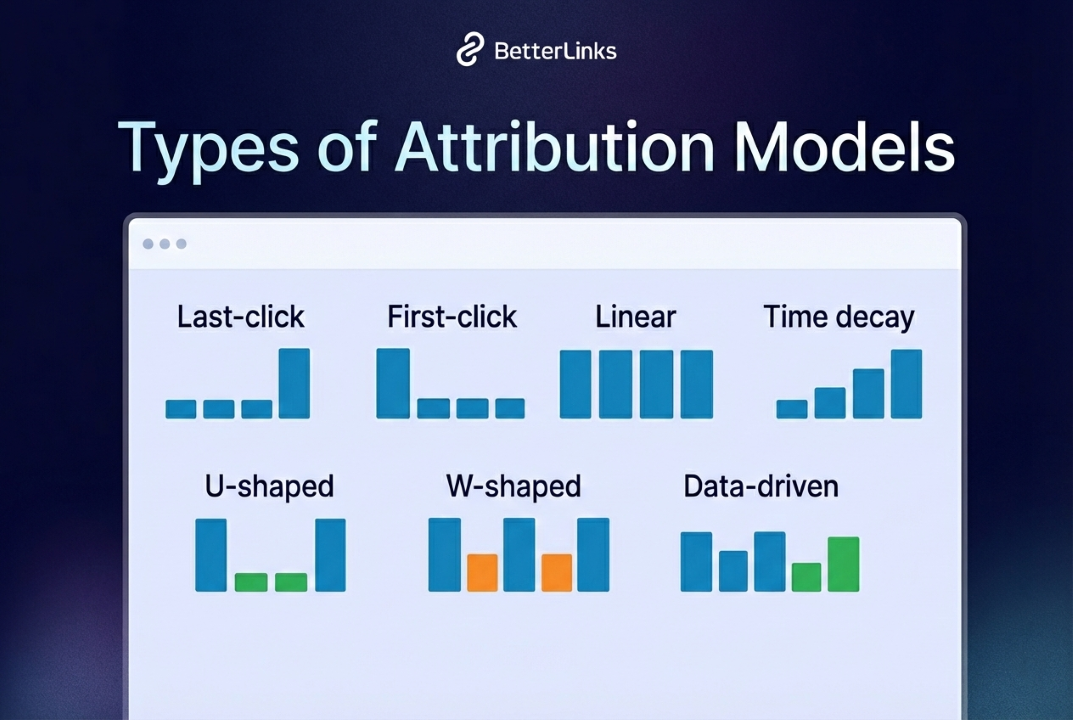
Move Beyond Last-Click Models
If you only track the last thing a customer did before buying, you will naturally underfund your most important top-of-funnel ads. You’ll end up pouring money into branded search while starving the prospecting campaigns that actually find new customers.
💡Compare different attribution models:
- First-Click: To see which channels are actually growing your audience.
- Linear: To see which channels are keeping users engaged throughout the journey.
- Position-Based (U-Shaped): To give credit to both the ‘introducer’ and the ‘closer.’
Create a Standardized UTM Taxonomy
Inconsistent naming (e.g., using ‘fb,’ ‘facebook,’ and ‘Facebook’ for the same source) fragments your data. If your data is messy, your attribution model will be wrong.
💡 Use a unified naming convention and an automated UTM builder. This ensures that your attribution platform can aggregate data correctly, allowing you to see the true ROI of a specific campaign across different platforms.
Feed ‘Clean’ Data Back to Ad Algorithms
Ad platform algorithms (like Meta or Google) optimize based on the conversions they can see. If your tracking is failing, the AI is learning from the wrong data.
💡 Use your attribution insights to ‘prime’ the ad platforms. By syncing server-side conversion data back to the ad networks, you allow their algorithms to optimize for actual revenue-generating customers, even if those customers have ‘opted out’ of traditional browser tracking.
UTMs are the building blocks, but they are not the house. You must connect click-level UTM data to a server-side attribution engine that captures the full customer journey to win in 2026.
Strengthen UTM Tracking for Better Marketing Attribution
You do not have to wait until you have a massive budget to start improving. The first step is to clean up your current data. Even though UTMs have problems, they are still useful for basic organization. You should have a clear naming convention for all your links so your data stays neat.
Next, you should look into server-side tagging. This will immediately make your data more accurate by bypassing browser restrictions. It is one of the best ways to fight back against cookie deprecation.
You should also start collecting more first-party data. Ask your visitors to sign up for a newsletter or create an account. When you have their email address, you can track their journey much more effectively without needing to follow them with cookies. This is the most stable foundation for your future marketing analytics.
Properly managing UTM links can enhance attribution accuracy and provide better insights into your campaigns.
🟢 Maintain Strict Naming: Use consistent naming conventions for sources, mediums, campaigns and content. This avoids confusion and ensures that data is clean and easy to analyze.
🟢 Avoid Internal Link Tracking: UTM links on internal navigation can create false referral data. Only use UTMs for external marketing campaigns to maintain accurate attribution.
🟢 Add Additional Attributes: Include extra parameters like term or content to capture more context about each click. This can help differentiate campaigns that target similar audiences or use multiple creatives.
🟢 Use URL Shortener: Long UTM links can look messy and discourage clicks. A URL shortener makes links cleaner, easier to share and can provide additional tracking insights.
Key Steps to Improve Marketing Attribution in 2026
- Audit your current UTM tracking to make sure it is consistent.
- Switch to the GA4 attribution model if you are still using older versions.
- Explore UTM tracking alternatives like server-side events.
- Talk to your team about the limitations of traditional tracking so everyone is on the same page.
What Is the Relationship Between Cookieless Attribution And UTM Tracking?
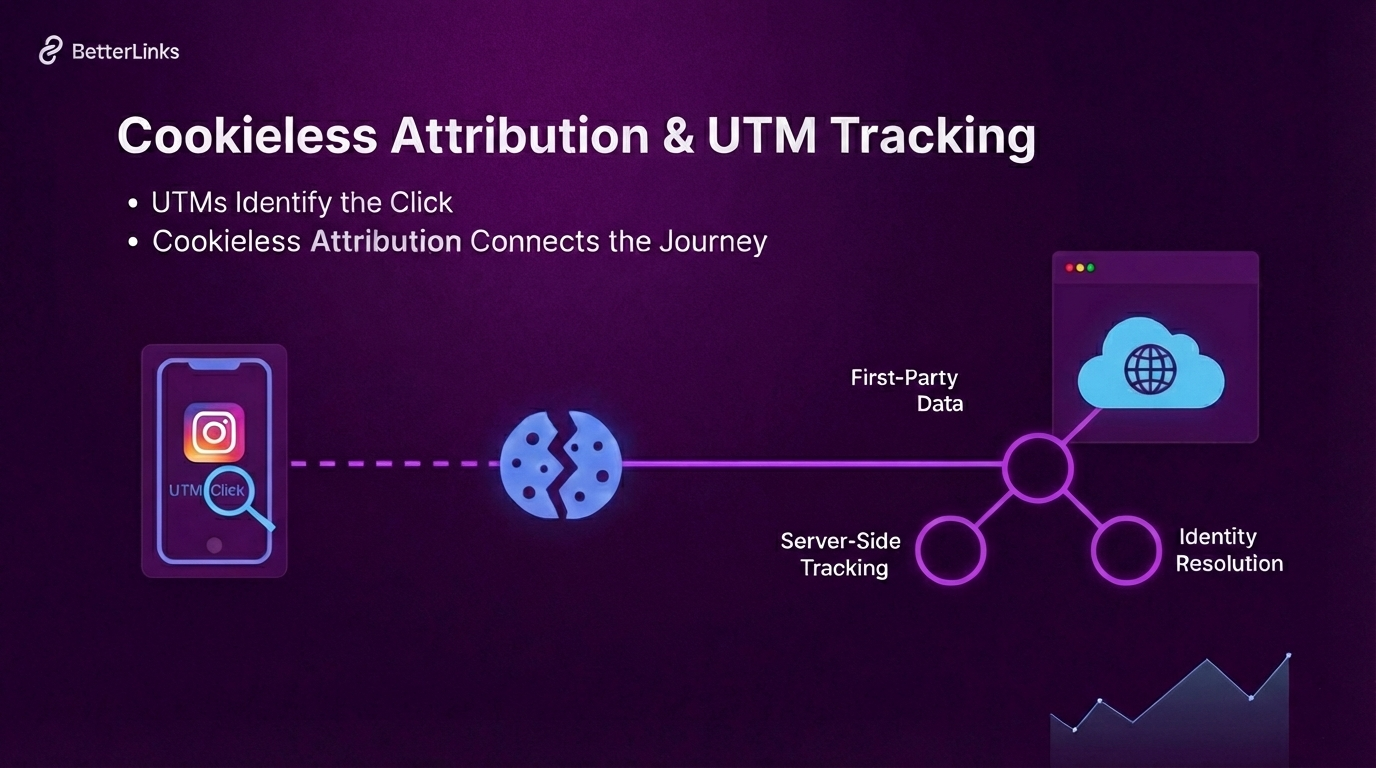
Cookieless attribution does not replace UTM tracking. Instead, it builds on it.
UTM parameters still identify where a click comes from. They tell you the source, medium and campaign. However, UTMs alone rely heavily on cookies to connect user sessions across time. When cookies are blocked or expire, that connection breaks.
Cookieless attribution steps in to fill those gaps.
For example, a UTM link may show that a visitor came from an Instagram campaign. If that visitor returns later without cookies enabled, traditional tracking may treat them as a new user. A cookieless system can use first-party data, server-side tracking, or identity resolution to reconnect those sessions and preserve the journey.
How They Work Together
Probabilistic attribution uses patterns and statistical models when direct identifiers are missing. If a user interacts with multiple channels but cannot be tracked through cookies, the system estimates the likely contribution of each touchpoint based on historical behavior.
Deterministic attribution uses logged-in data or known identifiers. If a user logs into your platform on mobile and later on desktop, the system knows it is the same person. This creates a much clearer and more accurate journey than relying only on browser cookies tied to UTM clicks.
Server-side tracking strengthens both approaches. Instead of depending entirely on the browser, your server collects and forwards event data to analytics and ad platforms. This reduces data loss from ad blockers or browser restrictions and ensures that UTM parameters are preserved when possible.
Technologies Used in Cookieless Attribute:
- The use of a customer data platform (CDP) to store all user information in one place.
- Identity resolution tools that match different data points to one person.
- Incrementality testing to see what happens if you stop running certain ads.
- Server-side tracking to ensure data reaches its destination accurately.
What Are the New Trends in Marketing Attribution in 2026?
As we look at marketing attribution in 2026, we see some exciting new trends. One of the biggest is the use of artificial intelligence. AI can look at millions of data points and find patterns that a human would miss. It can predict which customers are likely to buy before they even make a move.
We are also seeing a focus on cross-channel attribution. This means looking at how your TV ads or podcasts affect your online sales. In the past, these things were kept separate, but now we have the tools to see how they work together. This provides a much more complete view of your marketing measurement.
B2B marketing attribution is also getting more advanced. In B2B sales, many people from the same company might visit your site. Modern tools can group these people to show you how a specific company is moving through your sales funnel. This is much more useful than just seeing individual clicks.
Which Marketing Attribution Trends to Watch in 2026?
Marketing attribution is evolving rapidly. In 2026, new trends are shaping how marketers track, measure and optimize the impact of every touchpoint in the customer journey.
Predictive Attribution
Predictive attribution uses historical data and patterns to forecast which marketing channels and campaigns are likely to drive future conversions. This helps marketers plan budgets more effectively, focusing resources on the touchpoints most likely to deliver results.
Modeled Data Over Real-Time Data
Instead of relying solely on real-time tracking, modeled data uses statistical techniques to fill gaps in user behavior and attribution. This approach provides a more complete and accurate view of performance, especially when some interactions cannot be tracked directly.
CRM And Ad Platform Integration
By connecting your CRM with ad platforms, you can track conversions more accurately across both online and offline touchpoints. This integration ensures that marketing performance data from all channels feeds into a single system, giving a clearer picture of which campaigns actually drive revenue.
Media Mix Modeling (MMM)
Media mix modeling measures the impact of all marketing channels, including offline ones like TV, print, or radio. By analyzing patterns over time, MMM estimates how each channel contributes to overall sales, helping marketers optimize budgets across both digital and traditional media.
How to Choose the Right Tools for Marketing Attribution in 2026?
You need the right tools to succeed in this new environment. Standard analytics tools are still important, but they might not be enough on their own. You may need specialized software that can handle identity resolution and complex modeling.
BetterLinks is a great example of a tool that helps you manage your links and data more effectively. It allows you to shorten links and track them while keeping your data organized. When you use professional tools, you reduce the risk of manual errors that can ruin your reports.
You should also look for tools that integrate easily with your CRM. This allows for true CRM attribution tracking, where you can see exactly which ad led to a specific dollar amount in revenue.
Which Features Should You Look for While Picking Up the Tool?
- Support for server-side tracking and first-party data.
- Easy integration with Google Analytics and other major platforms.
- The ability to handle multi-touch attribution models.
- Clear reporting that even a beginner can understand.
The right software will do the heavy lifting for you. It will turn messy data into clear insights that you can use to grow your business. Do not be afraid to invest in quality tools because they will save you money in the long run.
BetterLinks: A Link Management Solution for Modern Marketers
If you are looking for a way to stay ahead of the curve, BetterLinks offers a powerful set of features. It is designed to help you handle the evolution of marketing attribution with ease. It goes beyond simple link shortening to provide deep insights into your traffic.

One of the best things about BetterLinks is how it helps you stay organized. It prevents the common problems with UTM parameters by providing a clear interface for managing your tags. This ensures that your data is always clean and ready for analysis.
It also helps with the transition to a more privacy-focused world. By providing robust tracking options, it allows you to maintain a high level of accuracy even as traditional methods fail. It is a perfect choice for anyone looking for UTM tracking alternatives that are easy to use.
Why consider BetterLinks for your strategy:
- It simplifies the process of creating and managing tagged links.
- It provides a centralized dashboard for all your marketing performance data.
- It helps you avoid the ‘broken link’ problems that can hurt your SEO.
- It is built with modern marketing challenges in mind.
Common Mistakes to Avoid in Marketing Attribution Strategy
As you upgrade your attribution strategy, there are some common mistakes to watch out for. The first is trusting your data too much without questioning it. Always remember that no tool is perfect. There will always be some ‘noise’ in your reports and you should account for that.
Another mistake is focusing too much on one single channel. If you only look at Facebook data, you will miss how your Google ads are helping. Cross-channel attribution is essential because your customers do not live in a vacuum. They are constantly moving between different apps and websites.
Data tells you what happened, but it does not always tell you why. You should still talk to your customers and ask them how they found you. This qualitative data is the perfect companion to your quantitative marketing analytics.
Avoid These Common Mistakes:
- Relying on last-click attribution for a complex B2B sales cycle.
- Forgetting to update your tracking when you launch a new website.
- Ignoring the impact of mobile app traffic on your desktop sales.
- Failing to explain the value of attribution to your leadership team.
Final Thought for Embracing the Marketing Attribution Change
Traditional UTM tracking is no longer the magic solution it once was. While these changes might seem scary, they are actually a good thing for the industry. They force us to be more creative and more respectful of our customers’ privacy. By focusing on first-party data and modern attribution models, we can build more sustainable and profitable businesses.
The key to success is to stay proactive. Start auditing your data today and look for tools that can help you bridge the gap between the old world and the new. Whether you are a small business or a large corporation, the principles of good measurement remain the same. Focus on the customer journey, keep your data clean and always be willing to adapt.
Is this blog helpful? Join our Facebook community to stay updated with the latest blogs, product reviews and WordPress solutions. Subscribe to our blog for in-depth tutorials, tips and visit our social media platforms for the newest updates.