If your technical SEO strategy still treats URL slugs as just ‘the readable part of the link,’ you are losing ground in 2026. In an era dominated by AI Overviews, Retrieval-Augmented Generation (RAG) and strict crawl budgets, the URL slug has evolved from a simple user experience feature into a critical technical node.
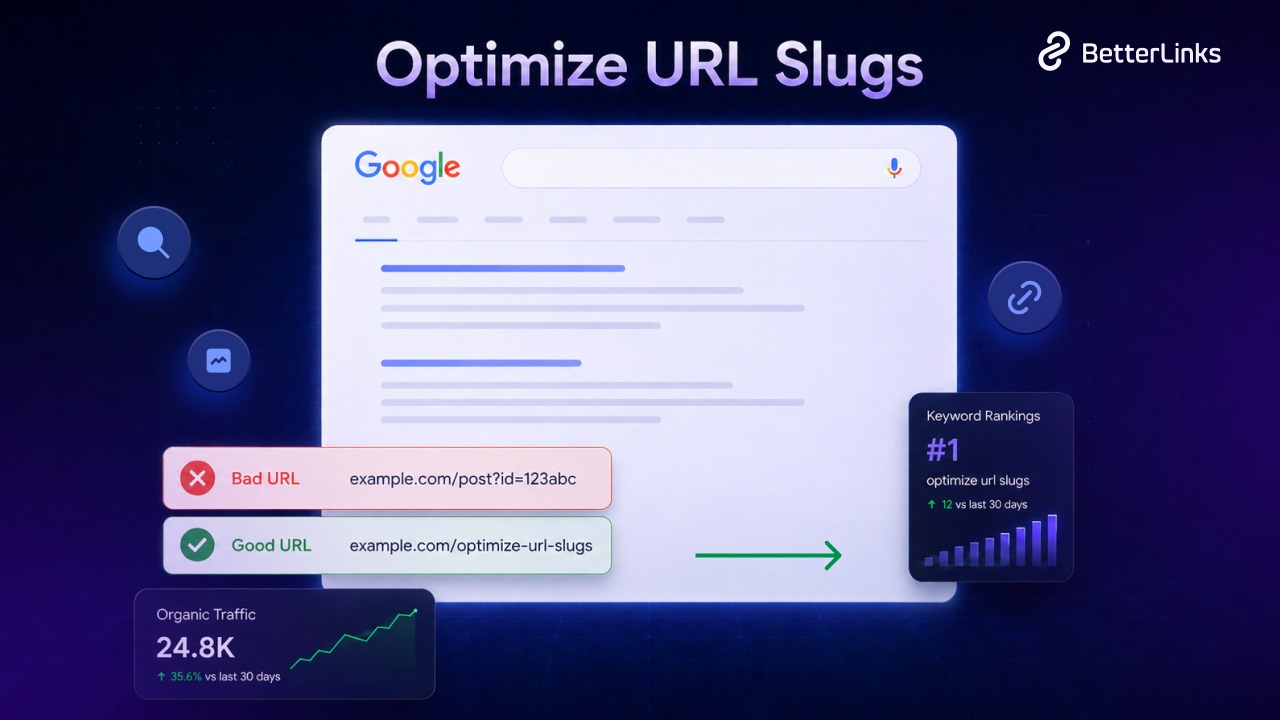
A poorly structured slug does more than confuse users, it wastes crawl budget, creates canonical conflicts and disrupts how Large Language Models (LLMs) parse your site’s entity graph.
This guide focuses on one clear goal: Optimizing your URL architecture for modern search engines and AI systems. We will move past basic advice and dive into the data, the technical ecosystem (canonicalization, parameters and crawl efficiency) and exactly how AI tokenizes your URLs.
TL;DR (Too Long, Didn’t Read?)
An SEO slug is the short, descriptive part of a URL that comes after the domain name and helps both search engines and users understand what a page is about.
| Topic | Key Takeaway |
| What is an SEO slug? | The readable part of a URL after the domain name |
| Why it matters | Affects rankings, click-through rates and crawlability |
| Best slug length | 3 to 5 words is ideal |
| Keyword placement | Include your focus keyword naturally |
| URL format | Use lowercase letters and hyphens only |
| AI search (GEO) | Clean slugs improve AI discoverability |
| Common mistakes | Stop words, dates, numbers and special characters |
✅ Keep slugs short, clear, and descriptive.
✅ Use keywords naturally (avoid stuffing).
✅ Replace spaces with hyphens for readability.
✅ Remove stop words and unnecessary filler.
✅ Keep them lowercase for consistency.
✅ Make each slug unique to avoid duplicate content issues.
✅ Test and update slugs to improve click‑through rates.
What Is an SEO Slug & Why Does It Matter?
An SEO slug is the last part of a URL that identifies a specific page. For example, in the URL https://betterlinks.io/seo-slug-best-practices, the slug is seo-slug-best-practices.
The slug is not just a technical label. It is a direct signal to search engines about what your page covers. URLs with relevant keywords tend to rank better because they match what users are searching for. A clean, descriptive slug also increases your click-through rate (CTR) because users can tell what the page is about before they even click.
Google AI Overviews and ChatGPT are reshaping how people find information; your URL slug SEO strategy has become more critical than ever. AI systems parse structured signals from your URL to understand your content before they even read the full page. A messy or vague slug makes that job harder and lowers your chances of appearing in AI-generated answers.
How Slugs Actually Impact CTR & Indexing
Strong claims require data. While Google insists that keywords in URLs are a “minor” direct ranking factor, the indirect impact on Click-Through Rate (CTR) and indexing efficiency is massive.
CTR Impact
A comprehensive URL structure study by Backlinko, analyzing 4 million Google search results, found that short, descriptive URLs have a 45% higher CTR compared to long or cryptic URLs.
Crawl Budget and Indexing
According to Google Search Central, ‘overly complex URLs with multiple parameters can prevent complete indexing.’ Furthermore, Google’s own analysis of crawl budget reveals that faceted navigation and session identifiers (which manifest as dynamic URL parameters) are the number one cause of low-value-add URLs that waste crawl capacity.
The Reality of URL Sprawl
Enterprise SEO platforms like Lumar and Screaming Frog consistently document that when sites rely on dynamic, parameterized slugs (e.g., /item?id=8943&cat=shoes), it leads to ‘URL sprawl.’
URL Sprawl: URL sprawl refers to the problem of having too many unnecessary, overlapping or poorly managed URLs on a website, which dilutes SEO value and confuses search engines.
It often happens when sites generate multiple versions of the same page, use excessive parameters or maintain outdated domains and pages.
Search engines get trapped in crawling infinite variations of the same page. Consolidating these into single, static slugs (/mens-running-shoes) directly recovers this wasted crawl budget, allowing search engines to finally index your deeper, high-value content.
The Technical Ecosystem: Slugs, Crawl Budget & Parameters
Behind every strong SEO strategy lies a technical backbone that often goes unnoticed. Elements like URL slugs, crawl budget and parameters may seem small, but together they shape how search engines discover, interpret and rank your site.
Treating URL slugs as just random text is a mistake; they are the backbone of how search engines crawl and index your site.
Understanding this ecosystem is key to keeping your pages visible, efficient and competitive:
1. Preserving Crawl Budget
Crawl budget is the number of pages Googlebot will crawl on your site within a given timeframe. Deeply nested slugs (/blog/2026/04/category/seo/seo-slugs) force crawlers to parse multiple directory layers, wasting precious crawl time.
A flat URL architecture (/seo-slugs) ensures your most critical pages are only one or two clicks away from the root domain, maximizing crawl efficiency and ensuring faster indexing of new content.
2. Taming URL Parameters
Dynamic parameters (like ?sort=price or ?sessionid=123) appended to your root slug create near-infinite URL variations. If left unmanaged, search engines will crawl all these variations, trapping bots in spider traps and diluting your page equity.
🔧 Your core SEO slug must remain static. Use Google Search Console’s parameter handling to restrict crawling of tracking variables, and ensure your clean, static slug is heavily internally linked.
3. Canonical URLs: Protecting the Root Slug
When tracking tags or faceted navigation, appending parameters to your URL, it creates duplicate content. Your clean SEO slug must be established as the master version using a Canonical Tag (rel=”canonical”).
If a user visits /seo-slug-tips?utm_source=twitter, the canonical tag on that page must point directly back to the clean /seo-slug-tips. This consolidates all link equity and behavioral signals into your primary slug.
How URL Slugs Affect Search Rankings
URL slugs are more than just a technical detail; they act as a signal to both search engines and users about the relevance of your page. While most people focus on keywords in titles or meta descriptions, slugs quietly influence how Google interprets your content and how likely users are to click.
A well‑structured slug can strengthen topical authority, improve indexing speed and even give your page an edge in competitive search results.
Search engines use multiple signals to understand and rank a page. Your SEO-friendly URL is one of those signals. Here is how slugs directly impact your rankings:
🔴 Keyword relevance in the URL plays a role in how Google interprets page content. While Google has said exact-match keywords in URLs are a minor ranking factor, Backlinko’s research confirms that keyword-rich URLs tend to perform better in competitive SERPs because they reinforce topical relevance.
🔴 Crawlability and indexing are also affected. A clean URL slug without unnecessary parameters, random characters or excessive folder depth is easier for Googlebot to crawl and index efficiently.
🔴 User trust and CTR improve when the URL is readable. When someone sees a clear slug like /seo-slug-best-practices in a search result, they are more likely to click it than something like /p?id=3847&cat=2.
🔴 Backlink anchor text is also influenced by the URL. When someone copies and pastes your link without custom anchor text, the slug itself becomes the anchor. A keyword-rich slug helps with semantic relevance for your backlink profile.
SEO Slug Best Practices You Need to Follow
Getting your SEO slugs right is one of the easiest yet most impactful steps you can take to improve rankings. While they may seem like a small detail, slugs directly influence how search engines interpret your content and how users engage with your links.
By following proven best practices, you can make your URLs cleaner, more clickable and far more effective in driving traffic.
1. Keep It Short & Descriptive
The best slugs are concise. Aim for 3 to 5 words that clearly describe the page topic. Shorter slugs are easier for users to read and remember, and they leave less room for keyword stuffing errors.
For example:
- Good: /seo-slug-best-practices
- Bad: /the-ultimate-guide-to-seo-slug-best-practices-for-better-rankings-2026
Long slugs are not only hard to read but can dilute keyword density by adding too many irrelevant words between the signals Google looks for.
2. Include Your Focus Keyword
Your focus keyword should appear in the slug naturally. If your page targets ‘SEO slug,’ your slug should contain exactly that phrase. This directly supports keyword-focused URL structure and reinforces what your content is about.
Avoid forcing multiple keywords into one slug. One primary keyword is enough. Over-optimization can trigger spam signals.
3. Use Hyphens to Separate Words
Always use hyphens (-) between words in your slug. Never use underscores (_) or spaces. Google treats hyphens as word separators, while underscores are treated as connectors. This means seo-slug tells Google there are two separate words: “seo” and “slug.” But seo_slug reads as one combined word and loses keyword clarity.
4. Use Lowercase Letters Only
URLs are case-sensitive on many servers. Using uppercase letters in slugs can create duplicate content issues because /SEO-Slug and /seo-slug may be treated as two different pages. Always use lowercase to ensure consistency and avoid indexing problems.
5. Remove Stop Words
Stop words like ‘a,’ “’he,’ ‘of,’ ‘and’ and ‘is’ add length without adding SEO value. Removing them creates a cleaner clean URL structure.
For example:
- Before: /the-best-practices-for-an-seo-slug
- After: /seo-slug-best-practices
The second version is shorter, cleaner and more keyword-focused.
6. Avoid Dates and Numbers Unless Necessary
Adding dates like /2026/01/seo-slug-tips makes your content look outdated quickly. When the year changes, your URL either becomes misleading or requires a redirect. Evergreen slugs without dates rank longer because they remain relevant regardless of when someone finds them.
The only exception is for news articles or time-sensitive event pages where a date in the URL makes editorial sense.
7. Match the Slug to The Page Title
Your SEO permalink structure should reflect your page title closely. If your blog is titled “SEO Slug: Best Practices for Better Rankings,” your slug should be something like /seo-slug-best-practices. This consistency helps Google confirm that the URL and the content are aligned.
8. Avoid Special Characters & Parameters
Question marks, ampersands and percent-encoded characters in slugs make URLs look messy and difficult to share. They can also create crawlability issues. Stick to letters, numbers and hyphens only.
9. Do Not Change Slugs of Existing Pages without Redirects
If you update a slug on an already-indexed page without setting up a 301 redirect, you will lose all the backlink equity and ranking signals that page had accumulated. Always redirect old URLs to the new ones when making changes.
Clean URL Structure & Permalink Optimization
A clean URL structure is not just about aesthetics; it is a core part of SEO and user experience. Well‑optimized permalinks make your pages easier to understand, improve click‑through rates and help search engines crawl your site more efficiently.
By organizing URLs logically and keeping them concise, you create a stronger foundation for better rankings and smoother navigation.
Your permalink optimization strategy goes beyond the slug itself. It includes the full path structure of your website URLs.
A clean URL structure follows these principles:
- Domain + slug only for flat structures: betterlinks.io/topic
- Domain + category + slug for hierarchical sites: betterlinks.io/seo/url-slugs
- Avoid deep nesting beyond two folder levels
The best permalink structure for SEO depends on your site type. For blogs and most content sites, a flat structure with no categories in the URL tends to perform better because it keeps URLs short and avoids diluting link equity through multiple folder levels.
For WordPress users, the WordPress SEO slug setting is found under Settings > Permalinks. The recommended setting is ‘Post name,’ which gives you a clean /post-title structure. This is the simplest and most SEO-friendly default.
SEO Slug Examples: Good vs. Bad
Not every slug pulls its weight. A sharp, well‑crafted slug can lift your rankings and drive clicks, while a clumsy one risks confusing both search engines and visitors, quietly holding your site back.
Notice how the good slugs are short, lowercase, keyword-focused and free of dates and special characters. These are the short URLs for SEO that Google prefers.
Seeing real URL slug examples side by side makes the rules easier to apply:
| Page Topic | Bad Slug | Good Slug |
| SEO best practices | /p?id=1923 | /seo-best-practices |
| Link management tools | /the-top-10-best-link-management-tools-for-2026 | /link-management-tools |
| How to shorten URLs | /how-to-shorten-a-url-in-three-easy-steps-today | /how-to-shorten-urls |
| Internal linking guide | /blog/2022/04/19/guide-to-internal-linking | /internal-linking-guide |
| SEO slug tutorial | /sEO_Slug_Tutorial_For_Beginners | /seo-slug-tutorial |
GEO & AI Search: The Technical Reality of URL Parsing
Generative Engine Optimization (GEO) is a growing discipline that focuses on making your content easy to discover and cite by AI-powered search engines like Google AI Overviews, Perplexity and ChatGPT’s browsing mode.
Your SEO slug plays a surprising role here. When an AI system crawls and parses your content, the URL is one of the first signals it processes. A clear, descriptive slug helps AI models understand the context of your page before reading a single word of the body content. This directly improves AI discoverability strategies.
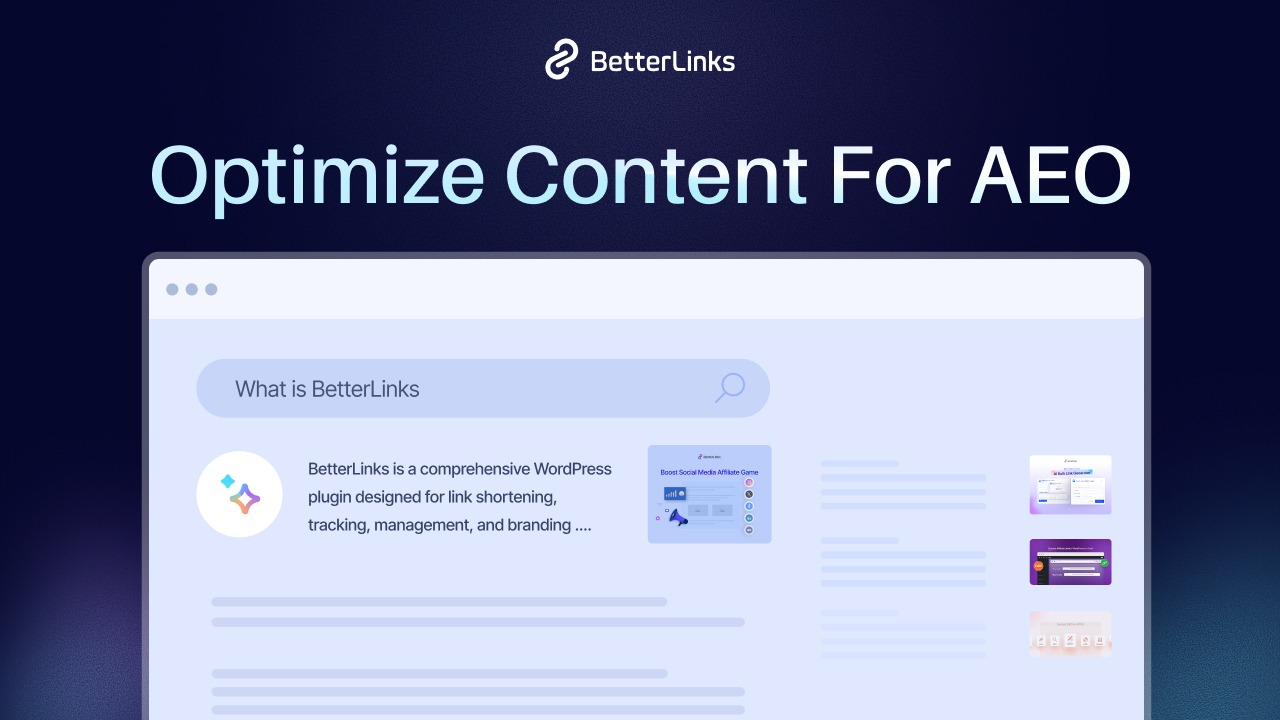
Optimize content for AI search by making every element of your page, including the URL, communicate a clear and consistent topic signal. This supports topical authority SEO because AI systems favor sources that demonstrate clear expertise on a narrow subject.
GEO requires understanding how AI systems actually read the web. They do not read pages like humans; they parse them using NLP (Natural Language Processing) and tokenization.
When an AI model scrapes a URL for a RAG response, the URL string itself is tokenized and fed into the vector database.
Semantic Vectoring
A slug like /technical-seo-audit is tokenized into specific semantic concepts (Technical, SEO, Audit). This acts as an immediate, high-weight relevance node before the AI even parses the <body> text.
Entity Disambiguation
AI relies on Knowledge Graphs. If your slug contains clear entity names (e.g., /google-search-console rather than /webmaster-tool), the AI can instantly resolve the entity, increasing your page’s “confidence score” for citation in AI Overviews.
Vague slugs (/post-id-112) force the AI to expend compute power extracting context purely from the page content, increasing the risk that your page is bypassed for a more clearly structured competitor.
GEO best practices specifically related to URL slugs:
- Use entity-based slugs that reflect the core topic clearly (/seo-slug-best-practices instead of /tips-for-urls)
- Avoid slugs with ambiguous abbreviations or jargon that AI systems may not resolve correctly
- Keep slugs semantically aligned with the H1 tag and meta description for contextual relevance
- Use structured content that pairs clean slugs with proper schema markup
Semantic SEO Strategies & Slug Optimization
Search engines no longer rely on keywords alone. They interpret meaning, context and relationships between topics. Your SEO slug plays a quiet but important role in shaping that understanding. A clean, intentional slug helps connect your content to the right topic cluster and strengthens how search engines classify your page.
When your slug is precise, it supports entity recognition, improves topical clarity and aligns your content with how modern search systems interpret intent.
How SEO Slugs Support Semantic SEO
| Semantic SEO Factor | What It Means | How Your SEO Slug Helps | Example |
| Entity Understanding | Search engines identify real concepts and objects | Use clear, specific terms instead of vague phrases | /seo-slug instead of /url-tips |
| Topical Authority | Websites build depth around a subject | Consistent, structured slug patterns under topic folders | /seo/on-page-seo and /seo/url-structure |
| Search Intent Clarity | Content matches what users are looking for | Slugs reflect the exact topic being covered | /seo-slug-best-practices |
| Contextual Relevance | Pages are understood within a broader topic network | Group related slugs under a clear category path | /seo/internal-linking |
| Language Alignment | Improves natural search interpretation | Use audience-aligned terms, not technical confusion | /seo-friendly-url vs /link-address |
Follow these guidelines to improve semantic strength and search clarity:
📌 Use the primary keyword form consistently.
Example: prefer /url-slug over mixed variations like /url-slugs
📌 Avoid unclear or mixed synonyms.
Example: /link-address weakens clarity compared to /seo-slug
📌 Keep slugs aligned with user language and search intent.
This improves performance in conversational and AI-driven search systems
📌 Maintain a consistent structure across your site.
This helps search engines map your content into strong topic clusters
Advanced Slug Optimization Techniques for 2026
SEO is evolving fast and what worked a few years ago will not guarantee results today. As search engines get smarter, slugs need to do more than just carry keywords, they must align with user intent, semantic search and technical efficiency.
In 2026, advanced slug optimization is about precision, adaptability and staying ahead of algorithm changes.
If you want to outrank competitors in a highly technical landscape, apply these advanced strategies:
1. Optimize for Tokenization, Not Just Keywords
Tokenization in slug optimization refers to the process of breaking down a slug (the part of a URL after the domain) into meaningful units, usually words or keywords so that search engines can better understand and index the content.
LLMs break down text into tokens. Stop words (and, the, of) waste tokens and dilute the semantic density of your URL.
🟠 Basic: /the-best-guide-to-seo-slugs
🟢 Advanced: /seo-slug-optimization (Maximum semantic density per token).
2. Map Slugs to Your Schema Markup
Your slug should perfectly mirror the primary “@id” or “name” entity defined in your page’s JSON-LD Schema markup. If your Article Schema defines the topic as “URL Architecture,” your slug should be /url-architecture. This cross-verification between URL and structured data provides search engines with a high-trust, unified signal.
3. Implement Entity-First Naming Conventions
Instead of focusing on long-tail keyword matching, focus on the core entity.
⬇️ Instead of: /how-to-fix-crawl-budget-issues-fast (Action-oriented, messy)
➡️ Use: /crawl-budget-optimization (Entity-oriented, authoritative). Entity-first slugs are much more likely to be cited as authoritative source material by AI search engines.
4. Audit for Keyword Cannibalization at the Slug Level
Audit your URL paths for overlapping entities with proper use of tools, eg, Screaming Frog. If you have /seo-slugs and /url-slug-tips, you are splitting your authority. Consolidate these overlapping topics into one master page with a single, authoritative slug and implement 301 redirects for the others.
How AI Search Changes Your SEO URL Strategy
The rise of AI-powered search has introduced a new layer to on-page SEO strategies for better rankings. Tools like Google AI Overviews now surface answers directly on the results page, often pulling from structured, well-organized content.
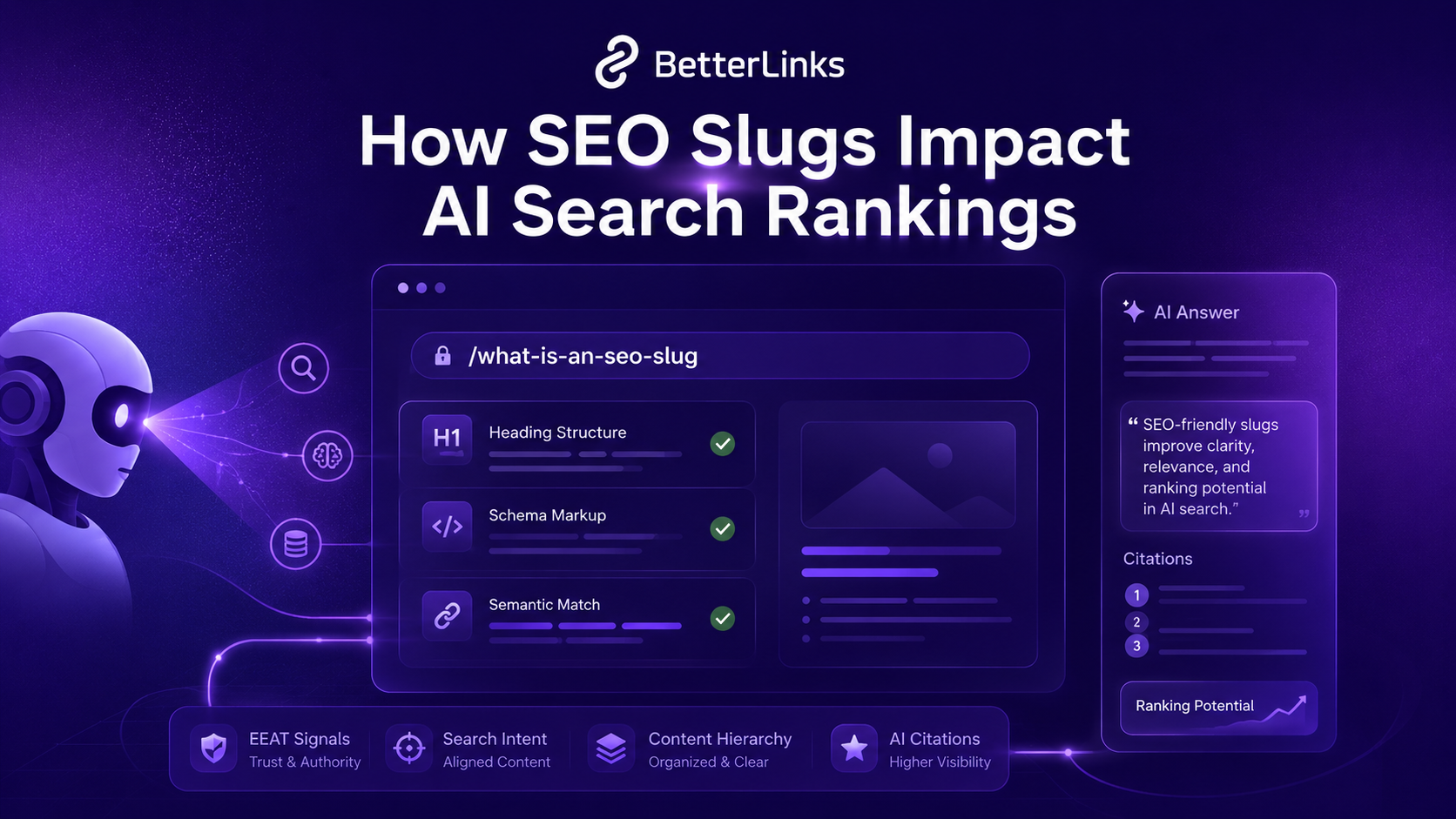
How AI search ranking factors relate to your slug strategy:
- Structured content optimization starts at the URL level. AI systems look for pages where the URL, title, headings and body content all reinforce the same topic. A mismatched slug (for example, a URL that says /marketing-tips but the page is about SEO) creates a semantic gap that reduces your chances of being cited by AI.
- EEAT optimization (Experience, Expertise, Authoritativeness and Trustworthiness) applies to your URL structure too. Authoritative content lives at clean, predictable URLs. Spam or low-quality content is often found at random, parameter-heavy URLs. Google’s AI systems have learned these patterns.
- Search intent optimization is critical. Your slug should reflect the intent behind the search query. For informational queries, a slug like /what-is-an-seo-slug matches the intent directly. For commercial queries, /best-seo-slug-tools works better. Aligning the slug with user intent improves both ranking and AI citation rates.
Common SEO Slug Mistakes to Avoid
A well-structured SEO slug helps search engines and users understand your content quickly. Small mistakes in your URL can reduce visibility, hurt click-through rates and weaken overall rankings. In this section, you’ll learn the most common SEO slug errors and how to avoid them for cleaner, more effective URLs.
Even experienced SEOs make these errors. Here is what to watch out for:
❌ Using Auto-Generated Slugs: Many CMS platforms default to slugs like /page-1 or /untitled-post-2847. These carry zero keyword value and hurt both search visibility and user experience.
❌ Copying the full title into the slug: A title like “The 10 Best SEO Slug Best Practices You Need to Know in 2026” becomes a messy slug if left uncleaned. Always trim and simplify.
❌ Using Category Prefixes Unnecessarily: Adding /blog/category/subcategory/post-slug adds folder depth that dilutes link equity. Unless your site architecture requires it, keep the path as shallow as possible.
❌ Ignoring Duplicate Slugs: If two pages share the same or very similar slugs, you risk cannibalization where Google cannot decide which page to rank for a given query. Each page should have a unique and distinct slug.
❌ Not Updating Outdated Slugs: A slug like /seo-tips-2019 makes your content look old even if you have updated the body. Evergreen slugs without years stay relevant longer.
How to Execute a Technical Slug Audit?
Using a link management tool like BetterLinks makes this process significantly easier. BetterLinks allows you to manage, redirect, track and scan all your links from one dashboard, which is especially valuable when you are restructuring URL slugs across a large site.
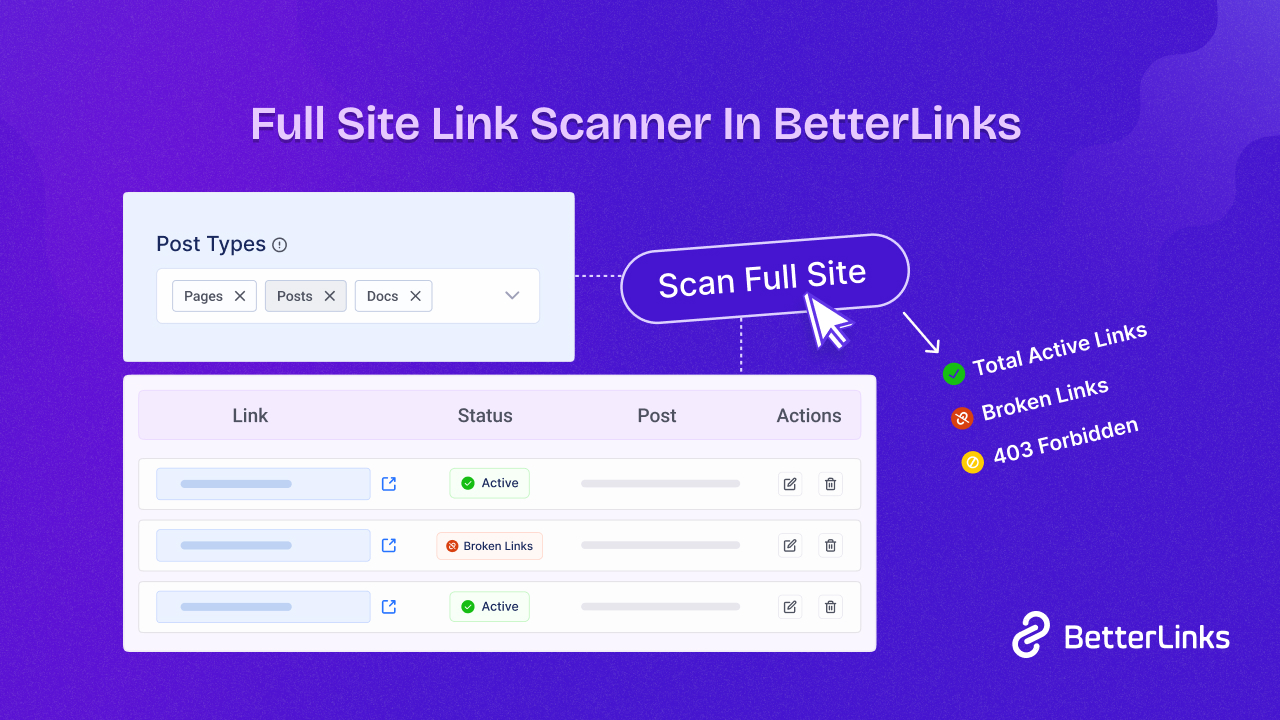
Changing an established slug is dangerous; it resets your URL history unless handled with perfect technical precision. If you must restructure to fix legacy errors (like dates or excessive parameters):
- Crawl & Map: Use a crawler (Semrush, Sitebulb) to map all existing indexed URLs.
- Identify Bottlenecks: Flag URLs with high parameter bloat, deep directory nesting (>3 folders deep), or duplicate semantic intent.
- Execute Server-Side 301s: Use a robust link management tool like BetterLinks to implement seamless 301 redirects from the old path to the new entity-focused slug.
- Update Canonical Tags: Ensure the new page self-canonicalizes to the updated slug.
- Force Recrawl: Submit the updated XML sitemap to Google Search Console immediately to process the redirect hops and preserve link equity.
Start Optimizing Your SEO Slugs
In 2026, your URL slug is a technical directive. It dictates crawl paths, anchors canonical authority and feeds direct semantic tokens to AI search models. By shifting your strategy from basic readability to technical and entity-based optimization, you build a site architecture that both Googlebot and modern LLMs can trust and prioritize.
Your SEO slug is one of the smallest elements on your page but one of the most powerful. Getting it right costs no money and takes only minutes per page.
Better rankings start with better structure. And better structure starts with something as simple as a clean, focused SEO slug.
Is your URL architecture holding you back? Join our Facebook community to stay updated on advanced technical SEO strategies or subscribe to our blog for deep-dive WordPress solutions.